The compact desktop is no longer a novelty. Offices replace towers with one litre machines, retail chains mount fanless boxes behind screens, and factories push inference to the edge. Every deployment needs a name on the enclosure, so distributors and first time founders keep asking the same three questions: what it costs, how small the first order can be, and how long goods take to ship.
Launching a Custom Mini PC brand does not require owning a factory. By choosing between private labeling, semi custom ODM work, and full hardware customization, founders can match their budget and timeline to the scope of the product they intend to sell. The three routes differ enormously in engineering effort, tooling investment, and minimum order quantity, so the right starting point is not a supplier negotiation but a decision about how far your product should deviate from a platform that already exists.
This guide covers what each route demands, what drives cost, what MOQ to expect, and how long development really takes.
What Does It Take to Launch a Custom Mini PC Brand?
A brand launch needs three things: a written product definition, a deliberate choice of customization depth, and a manufacturing partner able to execute that depth reliably. You are buying engineering and production capacity, not a shelf of finished goods, and you do not need to design a motherboard in order to own a brand.
The failure mode is rarely a bad idea, it is a vague one. Founders who arrive with a paragraph of intent end up comparing quotations for products that are not the same thing, and discover it only after tooling is cut. A written specification turns that into a scope discussion.
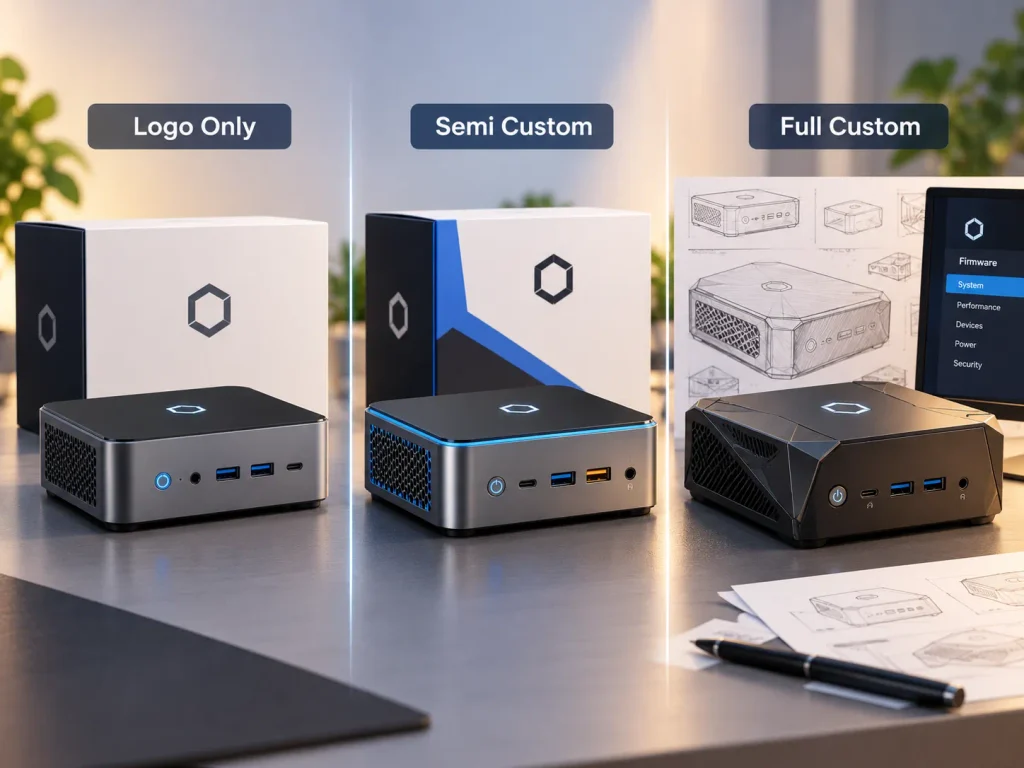
The Three Routes: Logo Only, Semi Custom, Full Custom
| Route | What changes | Engineering effort | Indicative opening order | Indicative development span |
| Logo only | Logo, packaging, system image, boot logo | Minimal | Low, a few dozen units | Weeks |
| Semi custom | Colour, ports, memory and storage, firmware features | Moderate | A few hundred units | One to three months |
| Full custom | New enclosure, new board layout, firmware, certification | High | Project dependent, several thousand | Five months or more |
These are indicative planning ranges, not published price lists. What a factory accepts depends on its existing tooling.
What an ODM Actually Turns Into Your Product
A requirements document fixes the platform, memory and storage, ports, display outputs, thermal envelope, target certifications, and expected annual volume. Industrial and mechanical design then resolve appearance, structure, airflow, and connector placement. Prototypes verify fit, thermals, and antenna behaviour before tooling is committed. Firmware covers the BIOS features customers notice, such as power on after power loss and wake on LAN.
Where a Custom Mini PC Build Solution Starts and Stops
Customization is real but bounded. You can change the enclosure, the port population, the firmware behaviour, the software image, the packaging and, at greater cost, the board layout. You cannot change the silicon roadmap behind the platform or the memory generation it supports. Knowing that boundary early prevents the most expensive mistake available: designing an enclosure around a component that will be gone when the mould is finished. Start from an existing Custom Mini PC Build Solutions baseline and list every deviation with its cost and lead time consequence.
How Much Does a Custom Mini PC Project Cost?
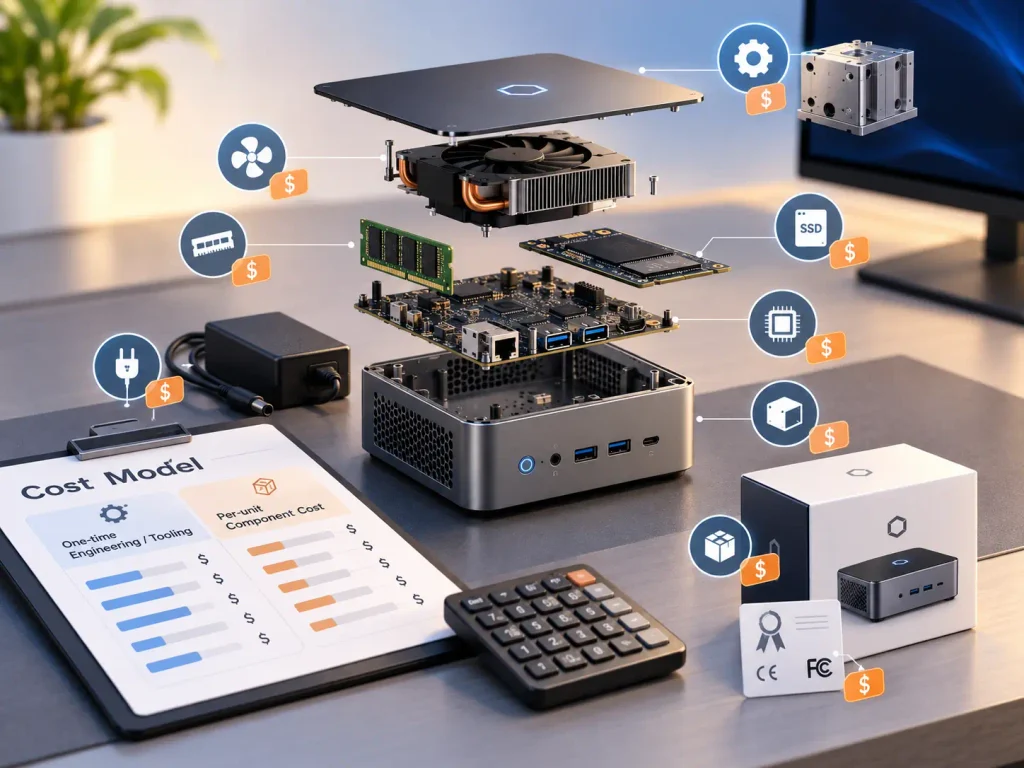
Project cost splits into one time engineering and tooling on one side, and a recurring per unit cost on the other. The one time portion is dominated by tooling and board work, the per unit portion by the bill of materials and assembly. Only the per unit part scales with volume, and the amortized share of the one time portion shrinks as the order grows, which makes volume the single largest lever on your landed cost.
Two mistakes appear in almost every first budget. Quoting a unit price without stating the order quantity hides an unknown tooling amortization. Double counting adds an item already inside the unit cost as a separate line. Both disappear once the budget is written as an explicit model.
One Time Cost: Engineering and Tooling
| Cost driver | What determines the amount |
| Design and board layout | Whether appearance and reference layout are reused or designed |
| Firmware and image | Depth of BIOS customization, licensed system or not |
| Tooling | Enclosure process, cavity count, mould life, modification allowance |
| Certification and pilot run | Target markets, certificate count, extra pilot run engineering fee |
Every item is quoted per project, so a price quoted without your specification describes a different product.
A Worked Example: Building a Unit Cost Model
Take the simplest defensible case: an entry level, low power x86 machine on a stock reference design with logo only customization, so no new tooling. Configuration is 16 GB of memory, a 512 GB solid state drive, dual display output, one high speed Ethernet port, and an integrated wireless module.
Unit Cost = BOM + Assembly + (NRE + Tooling) / Units
Assume 62 US dollars of materials, 4 US dollars of assembly and test per unit, and 6,000 US dollars of one time engineering.
| Order quantity | BOM | Assembly and test | Amortized one time cost | Unit cost |
| 1,000 units | 62.00 | 4.00 | 6.00 | 72.00 |
| 5,000 units | 62.00 | 4.00 | 1.20 | 67.20 |
These are model assumptions, not a quotation. They exclude freight, import duties, warranty reserve, returns handling, warehousing, and payment processing. The amortized line shrinks fivefold while materials do not move, which is why a small first order is not automatically the cheapest. Comparing Cost-Effective Mini PC configurations against your own model beats comparing headline prices across suppliers.
How to Bring the Cost Down Without Cutting Quality
The savings that hold up are structural. Reusing a reference design removes board engineering, and an existing enclosure removes tooling entirely. Piggybacking on a mould the factory already owns spreads that cost across other customers. Extending an existing certificate to a similar product is usually cheaper than obtaining a new one. Downgrading components the customer will notice does not work, because the cost returns later as returns.
What MOQ Should You Expect?
MOQ is set by the cost of changing a production line and by the cost of tooling, not by a fixed industry rule. As customization depth increases, setup work increases, and the minimum viable order rises with it. Suppliers publish indicative thresholds, but the number you are offered depends on the enclosure, the board modifications, component sourcing, and the production setup you agree to.
Treat any universal MOQ figure with suspicion. Two factories quoting the same unit price can be three hundred units apart in their opening order requirement, because one of them already runs a product close to yours. The useful question is what would have to be true for this factory to accept my order.
Why MOQ Exists
Production line changeover consumes hours of setup before a single sellable unit emerges, and that setup is spent regardless of how many units follow. Component suppliers impose minimum packaging and reel quantities, so a small order can leave you holding paid inventory. Tooling must be amortized across the units you buy.
Typical MOQ by Customization Level: What Suppliers May Require
| Customization level | Indicative opening order | Why the threshold sits there |
| Logo only, stock enclosure and board | Low, a few dozen units | No tooling |
| Configuration level semi custom | A few hundred units | Custom image, packaging |
| Hardware redesign in an existing enclosure | Project dependent | Board and firmware changes |
| Full custom enclosure and board | Project dependent, several thousand | New tooling, full validation |
MOQ depends on the enclosure, the printed circuit board modifications, component sourcing, and the production setup, so these ranges are indicative only. Confirm your figure in writing, including how many sample units are available before the mass production order. Reviewing a Wholesale Mini PC programme alongside a direct factory quotation gives a second reference point.
How to Negotiate a Lower Opening Order
- Adopt an enclosure the factory already produces.
- Accept a partially finished configuration and complete memory, storage, or branding yourself.
- Extend the delivery window so your order fits around larger runs.
- Take ownership of packaging artwork, the software image, and documentation.
- Phase the order: a certified first batch, then a volume commitment.
What Is the Realistic Timeline From Concept to First Shipment?
Total time to first shipment depends on how much of the product is genuinely new. A logo only project commonly runs in weeks, semi custom in a few months, and a fully custom platform in the better part of half a year or more. The most common planning error is treating that span as one lead time, when it is four separate clocks running on different schedules.
Quotations usually name only the production window, which is the shortest and the one you control least. Separating the four components shows where the real risk sits.
Timeline by Customization Route
| Route | Indicative development span | What drives the span |
| Logo only | Several weeks | Scheduling, image preparation |
| Semi custom | One to three months | Configuration changes, packaging, extra certification |
| Full custom | Five months or more | Design, tooling, validation, certification |
These are planning scenarios, not quoted lead times.
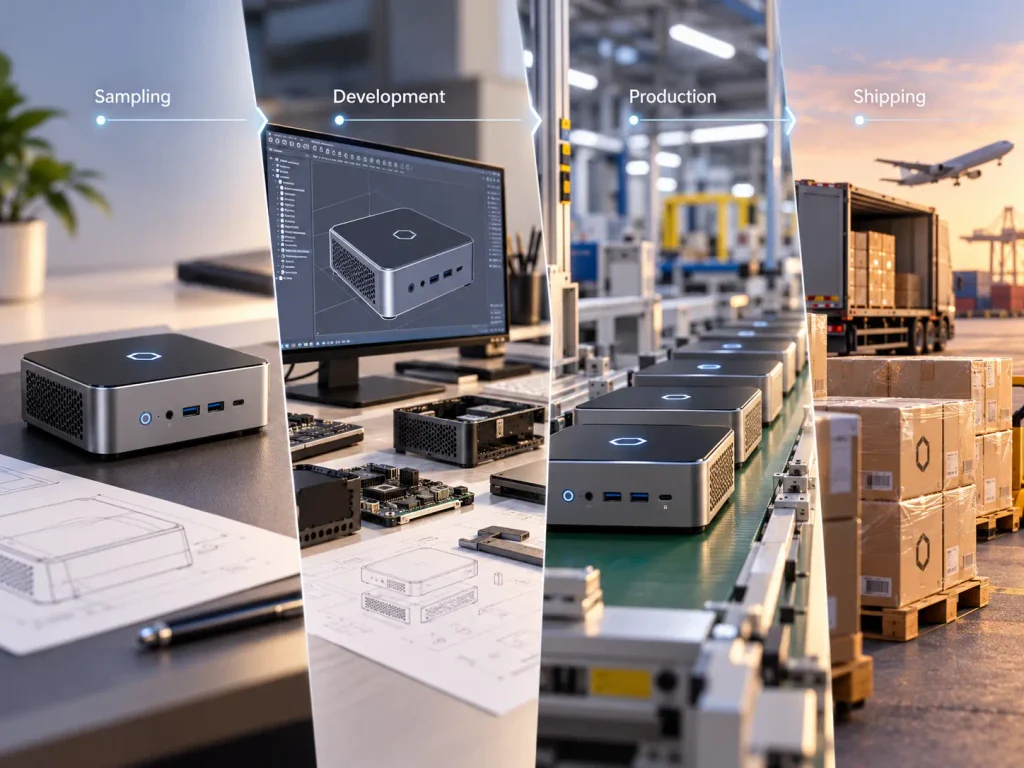
The Four Clocks: Sampling, Development, Production, Shipping
Sampling covers prototype units for approval and certification submissions. Development covers design iterations, tooling, and validation. Mass production covers material procurement and the build, and it is the figure suppliers usually quote. Shipping covers transit, and by sea it can be the longest single element.
Where the Schedule Slips and How to Compress It
Verification is usually described as a strict sequence of engineering, design validation, and production validation, though parts run in parallel. What cannot be parallelized away is the acceptance gate at each stage: fit, thermal behaviour under sustained load, wireless performance, and production first pass yield. Run certification concurrently with tooling, and freeze the specification before tooling is cut.
How Do You Choose the Right ODM Partner?
Choose a manufacturer rather than a middleman, and verify capability instead of accepting claims. The right partner employs engineers who answer technical questions directly, operates production and test capacity you can physically inspect, keeps traceable quality records, sources components through stable channels, and defines its after sales process in writing. Price is the last variable to compare, not the first.
A partner who cannot explain why a thermal solution was chosen will not fix it when the pilot run runs hot, so the qualification conversation matters more than the quotation document. Whether you deal with a factory or a trading intermediary changes who controls quality and schedule, so establish it early through Factory vs Trader verification.
A Five Point Factory Evaluation Framework
| Dimension | What to verify |
| Engineering | Board design, firmware and BIOS work, thermal simulation |
| Manufacturing | Assembly lines, burn in, test stations, daily output |
| Quality control | Traceable records, first pass yield data, first article reports |
| Supply chain | Sourcing transparency, safety stock policy |
| After sales | RMA process, repair turnaround, spare parts commitment |
What to Ask Before Requesting a Custom Mini PC Quote
Answer these first, because an incomplete request produces an incomplete answer: target application, processor tier, memory and storage, ports and displays, operating temperature range, target markets and their certification requirements, and expected annual volume. Then ask the supplier five things. What the engineering fee covers and how many revisions are included. Whether tooling is amortized and whether it becomes refundable above a volume threshold. Lead times for samples, production, and delivery, and the penalty for slippage. How long spare parts remain available after discontinuation. And which certifications the factory already holds.
Certification, Quality Control, and the Risks That Sink First Orders
Certification is not paperwork completed at the end of a project. It determines whether your goods may legally enter a market at all, and it must be settled before mass production begins. Quality should be judged on three separate measures rather than one blended figure: first pass yield, critical defect rate, and outbound sampling acceptance. Acceptable thresholds are not universal, and you and the manufacturer set them together based on how the product will be used.
Certification and Compliance by Market
| Market | How to approach it |
| China | Determine whether the unit falls within the applicable compulsory certification catalogue |
| European Union | CE conformity assessment applying whichever directives fit: electromagnetic compatibility, radio equipment, hazardous substances |
| United States | FCC equipment authorization by Certification or Supplier’s Declaration of Conformity, with the wireless module’s approval and integration checked separately. See the FCC equipment authorization programme |
| Japan | Identify the applicable electrical safety category and radio requirements |
CE marking obligations are set out on the European Commission’s CE marking pages, which note that not every product must carry the mark, since applicability depends on the harmonisation legislation covering it. When you change a wireless module, the antenna, or the installation conditions of an already certified product, the applicable compliance requirements must be reassessed and, where necessary, supplemented with additional testing or certification. An existing certificate should not be assumed to transfer unchanged.
Three Quality Measures That Actually Predict a Good First Order
First pass yield is the share of units that clear every station without rework, and it is the clearest early signal of whether the process understands your product. Critical defect rate counts failures that make a unit unusable or unsafe, and it must be tracked separately, because a low cosmetic figure means nothing if the critical figure drifts upward. Outbound sampling acceptance, usually expressed through an accepted quality limit, governs what proportion of shipped units may carry each class of defect. These measure different things and should never be blended into one score. Agree the numbers with your manufacturer against the product’s intended environment.
Are Mini PCs Worth Building a Brand Around?
Yes, but not as a commodity. The category is growing steadily rather than explosively, and the growth is unevenly distributed. Office and education deployments are mature and highly price sensitive, while digital signage, industrial edge computing, and locally run AI workloads carry better margins because they depend on qualification, input and output flexibility, thermal engineering, and lifecycle support that a generic box cannot supply.
What the 2026 Numbers Actually Say
Global market research places the mini PC market at approximately 24.7 billion US dollars in 2025, rising to about 25.9 billion in 2026 and forecast to reach about 46.3 billion by 2035, a compound annual growth rate of roughly 6.6 percent. The published mini PC market forecast also shows ARM based systems growing considerably faster than the larger x86 installed base. The honest reading is steady expansion with a changing revenue mix, not a gold rush.
Which Segment Should a New Brand Enter?
| Segment | Demand characteristics | Platform direction | Engineering focus |
| Office and education | High volume, price sensitive | Entry level low power x86 | Standardised image, remote management |
| Digital signage and retail | Many unattended units, always on | Entry level to mid range | Restart behaviour, display outputs, mounting |
| Industrial and edge AI | Lower volume, higher margin | Mid to high performance with AI acceleration | Sustained thermal load, wide temperature, software support |
| Gaming and high performance | Enthusiast demand, differentiation | Performance processors with capable integrated graphics | Cooling headroom, power delivery, acoustics |
Edge AI deserves separate treatment rather than a processor label. Whether a platform suits an AI workload depends on the acceleration hardware it carries, the memory capacity and bandwidth available to it, the thermal solution’s ability to sustain that load continuously rather than in bursts, and the maturity of the drivers and software support for your chosen frameworks. A tier that looks sufficient on paper can still fail because memory is soldered below what the workload needs. The same discipline applies to gaming, where graphics capability, memory bandwidth, cooling headroom, and port bandwidth matter far more than core count. Choosing a platform family that matches the workload, such as a High-Performance Mini PC tier, keeps the specification honest.
Which Customization Route Should You Choose?
Match the route to your uncertainty rather than your ambition. If you have not yet sold a mini PC, buy the cheapest possible validation. If you know precisely which interfaces and configuration your customers need, semi custom is the efficient middle ground. Commit to full custom only once demand is proven and your differentiation genuinely lives in the hardware itself.
| Your situation | Recommended route | Reasoning |
| First market test, limited budget, unproven demand | Logo only | No tooling, fastest to market, cheapest to repeat |
| Specific interfaces, ports, or configuration required | Semi custom | Functional differentiation at a fraction of full custom cost |
| Unique enclosure, board design, or dedicated platform | Full custom | Only when demand is proven and differentiation cannot be expressed otherwise |
The sequence matters more than the route. Most brand owners start with a logo only order, learn which configuration their market buys, and move up one level with evidence. If your target segment, configuration, and volume are already settled, bring your requirements and timeline to a Personalization Mini PC programme that begins with a specification review, and request a Custom Mini PC quote against a defined scope.
FAQ
Can I launch a mini PC brand without a hardware engineering background?
Yes, provided you invest in specification discipline rather than design work. Your role is to define the product in operational terms, target users, workloads, ports, environmental conditions, and volume, then judge whether the engineering answers are specific and verifiable. That ability comes from asking several suppliers the same questions and comparing the answers.
What is the difference between OEM and ODM in the mini PC industry?
An OEM arrangement means you supply the design and the factory manufactures it, which requires you to own or commission the engineering. An ODM arrangement means the factory already holds a developed platform and adapts it to your specification, which is what most new brands want. The commercial difference is where engineering risk sits. With ODM the platform is proven before you arrive. With OEM any design flaw is yours to find and fund.
Can I order a custom mini PC sample before meeting the MOQ?
Often yes, but sample units and mass production orders are quoted separately. Samples are usually produced through a small pilot batch rather than a standard line run, so the sample price is far higher per unit than the production price and is rarely counted toward the MOQ. Confirm in writing how many sample rounds are included, since second and third revision rounds are where sample budgets are usually exceeded.