Most compact computer projects no longer start from a blank sheet. A buyer arrives with a target price, a market and a launch date, then works backwards to a platform that already exists in a factory catalogue. The acronyms describing that relationship get treated as a formality, yet they settle who holds the drawings, who pays for the tooling and how much freedom the buyer keeps after the first shipment. For Mini PCs, the same labels decide whether a spare part or a firmware fix is still obtainable three years later.
Neither model is better in the abstract. OEM fits a project that already owns a design and can fund tooling and engineering, while ODM fits a project that needs a proven platform and can trade some design control for speed and a lower entry quantity. The first question to answer is who owns the design.
The rest of this guide follows that ownership line through tooling, cost, certification and risk.
What OEM and ODM Mean for a Mini PC Project
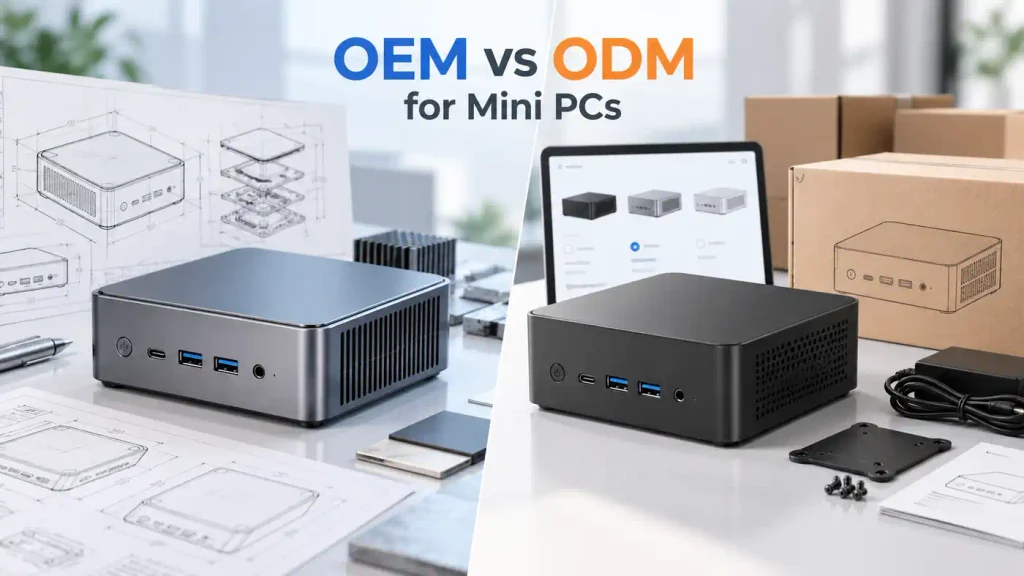
In manufacturing usage the two terms describe who brings the design. Under OEM the buyer brings it and the factory builds to it; under ODM the factory brings it and the buyer brings the brand, the channel and the market. The label changes what each side is responsible for, not the size of the order.
What OEM means in manufacturing
OEM stands for original equipment manufacturer, and the phrase is used from the buyer’s side: the factory builds the equipment, but the design and the specification come from the party placing the order. For Mini PCs, that means the buyer holds the enclosure geometry, the board layout or a validated reference, the thermal solution, the port map, the firmware image and the packaging artwork.
What ODM means, and how private label fits inside it
ODM stands for original design manufacturer, and here the base design and the tooling belong to the factory: a configuration is selected, the appearance is adjusted, software is preloaded and the product ships under the buyer’s brand. Private label sits at the lightest end of the same model, where a finished unit receives a label and minimal packaging. The practical test is the expectation of change. Private label implies almost none, while moving beyond it into customized Mini PC work means each change is quoted against the factory’s reference design.
Where OBM enters the picture
OBM, short for original brand manufacturer, describes a company that designs, builds and sells under its own brand, which is where a successful OEM or ODM project can eventually lead.The Real Difference Is Who Owns the Design
Ownership determines the cost and the speed of every change after the first shipment. If the design and the tooling belong to the buyer, changes run through the buyer’s drawings; if they belong to the factory, changes run through the factory’s roadmap and compete with its other customers for the same slot.
Design ownership and tooling rights depend on the manufacturing agreement, not the OEM or ODM label alone. What follows describes the typical arrangement, yet every item below should be confirmed in the contract before the first order ships.
Design files, tooling and the chassis mould
The enclosure is where ownership becomes visible. An aluminium extrusion or an injection mould carries a tooling fee, a lead time and a named owner, and how that fee is amortised is negotiable. A new colour or a printed logo is a surface treatment applied to a shell that already exists, which is why it sits inside the colorful Mini PC models rather than on a tooling invoice, while a new port layout or a taller heatsink changes the mould itself.
What the buyer keeps control of under each model
Control is rarely all-or-nothing, so check each item below.
| What you control | Under OEM | Under ODM | Consequence of a change |
| Design files | Typically the buyer’s; changes issued by the buyer | Typically the factory’s | New supplier needs a transfer agreement |
| Tooling | Typically funded by the buyer; ownership negotiable | Typically funded and owned by the factory | Shell cannot move to another line without agreement |
| Appearance | Any treatment specified | Buyer picks within a range | Colour change stays a surface treatment |
| Firmware | Buyer supplies the image | Factory image, buyer preloads | Update duty needs a named owner |
| Certificate and technical file | Typically the buyer’s if they placed the product on the market | Often the factory’s, but negotiable | Re-evaluation may be needed after design changes |
Cost, MOQ and Lead Time Side by Side
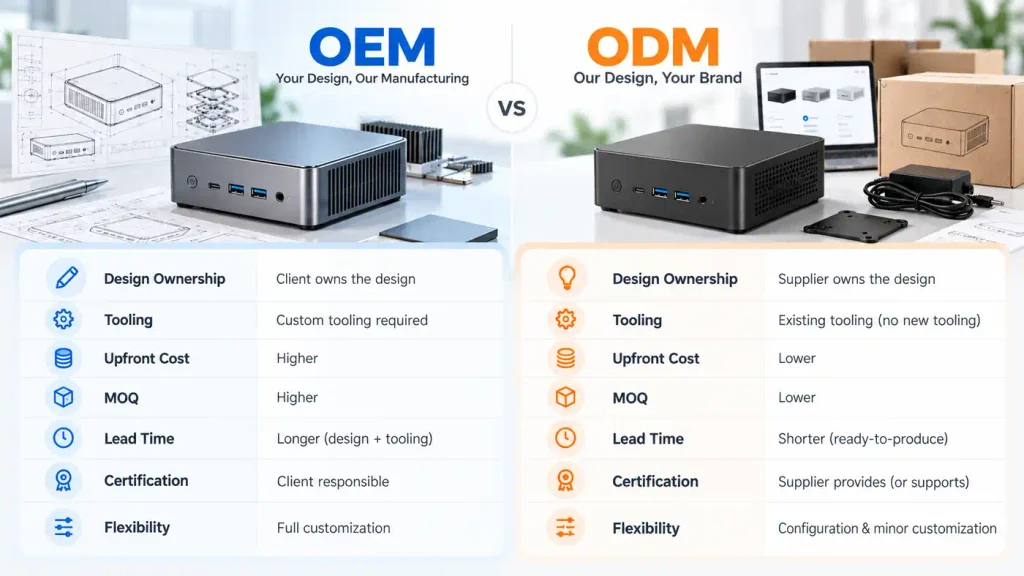
The two models spend money in different places, so comparing a single unit price for Mini PCs reveals very little. OEM front-loads tooling, engineering, prototype rounds and certification; ODM folds the engineering into the unit price and lowers the quantity needed to start, in exchange for a narrower change window.
What the buyer pays for in an OEM project
Front-loaded cost is the defining feature. Tooling is paid before the first saleable unit exists, engineering effort is billed whether or not the first prototype round passes, and a certificate issued in the buyer’s own name adds a separate line. The quantities that make this arithmetic work are higher, because a new mould has to be justified against a production run.
What the ODM price already includes
The unit price carries engineering someone else already funded, which is why the entry quantity is lower and the first shipment arrives sooner. That does not make the start free. Logo setup, packaging artwork, a preloaded image and a certificate derivative are usually billed separately.
| Commercial term | Under OEM | Under ODM |
| Tooling and moulds | Paid up front by the buyer | Not required unless the shell changes |
| Engineering and NRE | Billed as a separate line | Absorbed into the unit price |
| Unit price basis | Tied to volume commitment | Published against a catalogue unit |
| Minimum order quantity | Set by tooling investment | Set by the production slot |
| Time to first shipment | Longer, with prototype rounds | Shorter, once setup is paid |
How the two quotes look in practice
An OEM quotation usually lists tooling, NRE, prototype rounds, certification and the unit price as separate lines. An ODM quotation for the same platform shows one unit price that already contains the engineering, plus setup fees for branding and packaging. The difference is when the money leaves the buyer’s account. OEM front-loads the largest payments before the first saleable unit exists, while ODM keeps most of the cost inside the unit price. That is why a test market or a first launch usually leans toward ODM: the buyer can stop after a small batch without having funded a mould.
Certification, Firmware and After-Sales Responsibility
Compliance responsibility, test reports and the technical file matter more than the word certificate alone. Under ODM the factory often holds the test data, yet the party placing the product on the market may still carry the legal obligation. A design change can reopen the assessment, so the key question is who holds the evidence and who pays for a re-evaluation.
Who bears compliance responsibility and holds the technical file
Product compliance follows the party placing the item on the market, which is why CE marking places the conformity assessment obligation on the legal manufacturer rather than on the factory that assembled the board. The technical file and the test report are the real assets: without them, a label alone does not prove compliance. Where wireless connectivity is part of the platform, the Radio Equipment Directive adds its own essential requirements, and any change to the wireless module or the antenna arrangement reopens them. The EU Blue Guide sets out the wider framework for deciding who acts as the manufacturer and what evidence must be kept. Buyers should confirm who holds the technical file, whether a derivative or a fresh assessment is needed after a design change, and who pays for the re-evaluation.
BIOS, drivers and firmware continuity
The buyer may own the enclosure while the factory retains the firmware image, the boot logo and the driver package, which means shipping a security update or a compatibility fix depends on a supplier that may no longer prioritise the platform. The terms worth writing down are the notice period before a platform is retired, whether the buyer receives a signed image or the source to build one, and who publishes drivers and for how long.
Matching the Model to Your Project Type
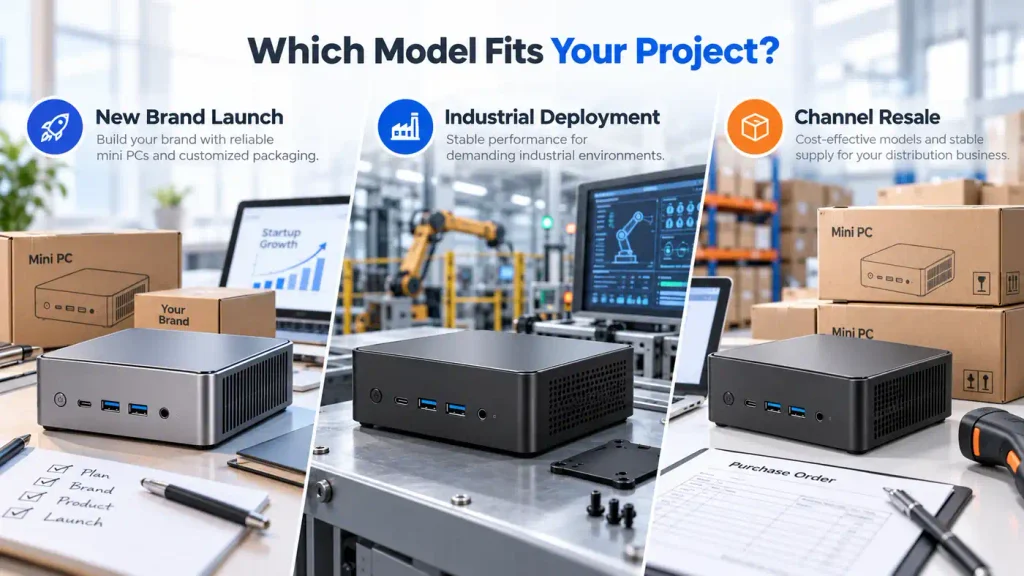
Project shape decides the model more reliably than company size does. A project with fixed technical requirements and a long horizon leans towards OEM, while a project with a committed launch date and an unproven market leans towards ODM.
Launching a brand with a short window
A first order is usually a market test, and a market test is poorly served by a mould. Working from an existing platform with a distinct appearance, packaging and preloaded software keeps the first shipment small and the feedback loop short.
Vertical and industrial deployments with fixed requirements
Deployments in signage, point of sale, control rooms and production lines arrive with a fixed port map, a fixed thermal envelope, a fixed system image and a service life measured in years. Those requirements are hard to satisfy inside a catalogue configuration, so the engineering work shifts to the buyer’s side. The same applies to wide temperature designs and to batches that must stay identical.
Volume resale and channel distribution
Channel businesses sell a published configuration at a published price, and their risk sits in inventory rather than in engineering. Resellers usually work from a wholesale Mini PC lineup in which the configuration is already fixed, so the sourcing questions turn on price band protection, availability and how quickly a model can be substituted when a platform is retired.
| Project profile | Best-fit model | Main reason |
| First launch, unproven market | ODM or private label | Speed and a low entry quantity |
| Fixed port map and system image | OEM | Cannot fit a catalogue model |
| Wide temperature or industrial duty | OEM | Thermal design has to be owned |
| Channel resale of a standard unit | ODM | Availability drives the decision |
| Long-life product with a service contract | OEM plus a continuity clause | Spares and firmware must outlive the launch |
The Risks That Usually Decide the Outcome
Price rarely sinks a project, while exclusivity and continuity frequently do. Two buyers can accept the same unit price and still end up with different results, depending on what the contract says about design and supply.
Exclusivity and freedom to operate
Shared platforms create two separate exposures. The first is commercial: an ODM product can reach a competing brand, and exclusivity has to be written as a clause with a territory, a duration and a quantity behind it, not assumed. The second is legal. Before launch, the buyer should establish who originated the design, whether any protected element is licensed, and what happens if a rights holder objects after the stock is made.
Supply continuity and end-of-life planning
How To Choose Mini PC Manufacturers sets out the checks that make a continuity clause enforceable, because a promise of advance notice is worth little if the party giving it does not control the line. The items that matter are the notice period before a platform reaches end of life, the last-time-buy window and how much stock the buyer must hold, and the spare parts ratio held against the warranty period.
A Practical Decision Sequence
Six questions, answered in order, settle the model for Mini PCs faster than a supplier comparison does, because each answer narrows the options left to the next one.
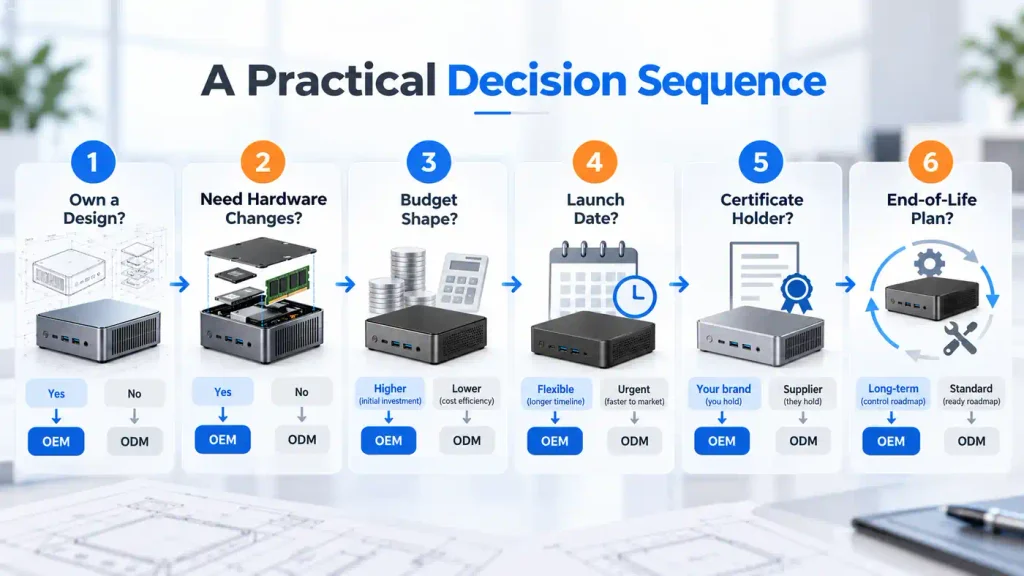
- Does the project already own a design that can be issued as a drawing? If yes, the OEM route is open. If the answer is a component wish list, it is not there yet.
- What has to change on the hardware? A colour or a logo points towards a catalogue platform, while a new port map or thermal design points towards new tooling.
- How is the budget shaped? Money available before the first saleable unit supports tooling and a certificate in the buyer’s name; money available after it suits a catalogue unit price.
- How firm is the launch date? A date that is already committed narrows the choice to platforms that exist today.
- Who has to hold the compliance evidence? If the buyer must act as the legal manufacturer, plan for a derivative or a fresh assessment rather than assuming a simple transfer.
- What happens when the platform is retired or the supplier changes hands? Write it into the contract before the first order, not after the first problem.
FAQ
The three questions below surface once the model has been chosen, when its practical consequences begin to show. They concern the first launch, a later move to an owned design, and who carries responsibility for spares and firmware after the sale. None of them repeats the body of this guide.
Is OEM or ODM a better starting point for a first mini PC product?
A first product is usually a market test, and ODM or private label keeps the entry quantity and the upfront commitment low enough to test demand without tooling. Choose OEM for a first product only when the design is already developed and the volume commitment can justify the mould, because an unproven market and an unproven design is the most expensive pairing.
Can a project move from ODM to OEM later without losing momentum?
It can, and the move is easier when planned early. The items to secure early are the rights to the tooling, a transfer agreement covering the design files, and a clear position on the technical file and compliance evidence, since documentation held by the factory has to be transferred or rebuilt before production moves. Starting under ODM does not close the OEM route by itself; leaving the transition unplanned does.
Who is responsible for spare parts and firmware updates under OEM and ODM?
Under OEM the buyer usually directs the spare parts source and owns the firmware image, so updates and replacements run through their own channel. Under ODM the factory normally controls the firmware and the component source, which means the buyer depends on the factory for updates and for the agreed spare parts ratio. The contract should name the owner, the notice period for firmware changes, and the repair route before volume production begins.
If you are weighing OEM against ODM for an upcoming Mini PC project, sharing the specification, volume target and launch date with the factory team is the fastest way to see which model matches your timeline and budget.