Why Finding a Good Mini PC for Gaming Is Harder Than It Looks
There’s no shortage of mini PCs on the market right now. Walk through any tech retailer’s website and the options pile up fast — different brands, different chip generations, wildly different price points. The problem isn’t availability. It’s that the spec sheets don’t always tell the full story, and a machine that looks great on paper can feel sluggish the moment a real game loads up.
What actually separates a decent gaming mini PC from a frustrating one comes down to a handful of factors that don’t always get enough attention in product listings.
It’s Not Just About the Chip
The processor matters, obviously. But in a compact form factor, how that chip behaves under sustained load is just as important as its benchmark score. A Ryzen 9 that throttles to 60% after ten minutes of gaming isn’t really a Ryzen 9 in practice — it’s something considerably less. Thermal design, fan curve, and chassis airflow all feed into this in ways that vary a lot between manufacturers.
Core Specs That Define a Good Mini PC for Gaming
Processor Generation and TDP
Older chips (pre-2022 in most cases) are starting to show their age in newer titles. The sweet spot right now sits around:
AMD Ryzen 7 7745HX or 8945HS for higher-end mini gaming builds
Intel Core Ultra 5/7 (Series 2) for more power-efficient options
Ryzen 5 7600 or similar for budget-conscious builds that still game reasonably well
TDP matters here. A chip running at 45W sustained will outperform the same chip capped at 15W — and some manufacturers quietly limit power to keep thermals manageable in smaller enclosures.
GPU: Integrated or Discrete
This is probably the biggest decision point. Integrated graphics have genuinely improved — AMD’s Radeon 890M in particular handles a surprising range of titles — but there’s still a ceiling. For anything graphically demanding released in the last year or two, a discrete GPU makes a real difference.
| GPU Type | Best For | Typical FPS Range (1080p, medium) | Limitation |
|---|---|---|---|
| Integrated (Radeon 780M/890M) | Esports, indie, older AAA | 50–90 FPS | Struggles with recent AAA |
| Integrated (Intel Arc) | Light gaming, media | 40–70 FPS | Driver maturity varies |
| Discrete (RTX 4060 mobile) | Most modern titles | 80–120+ FPS | Higher cost, more heat |
| Discrete (RX 7600M) | Mid-range AAA gaming | 70–110 FPS | Fewer mini PC options |
Discrete GPU mini PCs tend to be larger and pricier, but for anyone serious about gaming performance, the tradeoff is usually worth it.
RAM Configuration — Dual Channel or Don’t Bother
16GB is the baseline in 2026. More importantly, it should be running in dual-channel mode. Single-channel RAM can reduce integrated GPU performance by 20–30% in some titles — a meaningful hit that doesn’t show up anywhere in the product listing. Worth confirming before purchasing.
Storage
NVMe SSD is essentially non-negotiable now — SATA SSDs are noticeably slower for game loading
Check whether the unit has an open M.2 slot for future expansion
Avoid anything shipping with eMMC as primary storage
Build Quality and Thermals — The Underrated Part
A mini PC that runs hot will throttle. That’s just physics. The better-regarded brands in this space — MinisForum, Beelink, ASUS (with their NUC successors) — tend to invest more in cooling solutions than generic white-label options. Reviews that include thermal benchmarks under sustained load are worth seeking out specifically.
Things to look for in the chassis:
Copper heat pipes rather than aluminum-only solutions
Dual-fan setups in discrete GPU models
Venting on multiple sides, not just the bottom
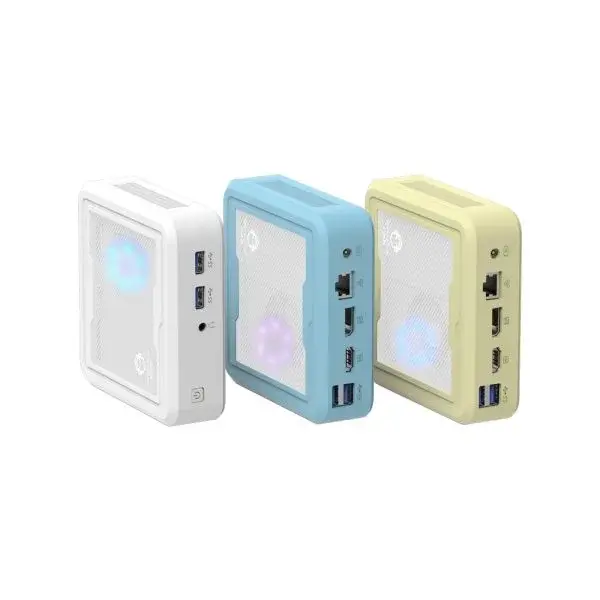
Connectivity Worth Checking
Not glamorous, but relevant. A good gaming mini PC should have at least:
HDMI 2.1 or DisplayPort 1.4 for high refresh rate output
USB4 or Thunderbolt 4 for eGPU potential down the line
Wi-Fi 6E or 7 if ethernet isn’t an option
FAQ
Can a mini PC replace a gaming desktop in 2026?
For casual to mid-range gaming, genuinely yes. For high-end 4K gaming or competitive play at very high frame rates, a full desktop still has the edge — but the gap has narrowed considerably.
Are mini PCs upgradeable?
RAM and storage are usually upgradeable. The CPU and GPU are almost always soldered, so what you buy is largely what you’re stuck with long-term.
What’s a realistic budget for a good mini PC for gaming in 2026?
Around 500–500–700 gets a solid integrated GPU build. For discrete GPU performance, expect 700–700–1,000+. Under $400 is possible but involves real compromises on sustained performance.